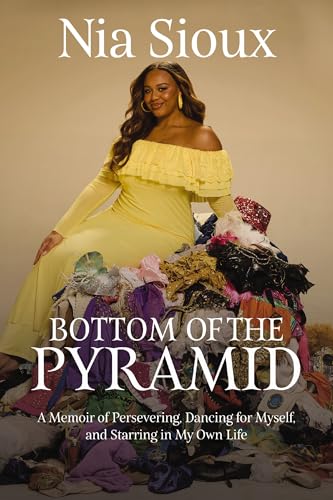
Book Review: Bottom of the Pyramid: A Memoir of Persevering, Dancing for Myself, and Starring in My Own Life by Nia Sioux
Foreword by: Chloe Lukasiak
Rating: ★★★★☆ (4/5)
Introduction
Reading Bottom of the Pyramid as a parent — and as a mother to a toddler currently in dance — was an emotional experience. But beyond the familiar toxicity of competitive dance culture, this memoir adds a layer that is often minimized or ignored: the racial undertones Nia Sioux endured as a Black girl in an environment that consistently treated her as lesser, interchangeable, or expendable.
This book didn’t just upset me — it affirmed my refusal to place my child anywhere near adults who confuse cruelty, bias, and control with “discipline” or “excellence.”
In Bottom of the Pyramid, Nia Sioux recounts her experience growing up in a highly competitive dance environment where favoritism, emotional abuse, and racial bias were normalized. While others were praised, protected, or elevated, Nia was consistently underestimated, excluded, and held to a different standard — all while being expected to remain grateful for the opportunity.
Rather than centering fame or spectacle, the memoir focuses on what it costs a child to grow up in a system that quietly tells her she does not belong.
Quick Facts
- Release: November 2025
- Read: December 2025
- Reading Time: Quick read, emotionally heavy
- Pages: 256
- Format Recommendation: Physical or ebook to pause and process; audiobook may intensify the emotional weight.
- Perfect for: Parents, dancers, and readers interested in stories about resilience, racism in competitive spaces, and reclaiming self-worth.
Genre and Writing Style
- Genre: Memoir / Nonfiction
- Writing Style: Reflective, clear, emotionally honest
- Spice Level: 🌶️ (none)
- Trigger Level: 💀💀💀💀 (emotional abuse, racism, childhood trauma, toxic authority figures)
Summary: A Brief Overview (Without Major Spoilers)
From Goodreads:
When you’ve been told over and over that you belong at the bottom, how do you come out on top? Dance Moms star and triple threat Nia Sioux shows the way via her story of resilience, triumph, and defining success for herself.
Young dancer Nia Sioux was only nine years old when she stepped into stardom as one of the original cast members of Lifetime’s reality TV show Dance Moms. Nia learned new choreography week after week and competed against dancers from across the country as well as at her own studio. Perhaps her greatest obstacle was suffering through her dance teacher’s ranking of the girls against each other in her infamous pyramid, where Nia spent the majority of her time on the bottom—all in front of an audience of millions.
But there was much that viewers didn’t see. How her experiences in the studio went far beyond what made it into the show. How she was ostracized for not fitting into an aesthetic that wasn’t designed for girls like her. How her friendships and her mental health crumbled under the strain of the show. How she lost control of her story and her voice.
But don’t be fooled—this is a story about resilience. Nia is not looking for pity, sympathy, or validation as she reflects on her experiences. Instead, she is choosing to use her story as a celebration of triumph. Nia finally gets to tell her story in her own way and in her own words. In this captivating memoir, Nia reclaims both the spotlight and her narrative.
In addition to going behind the scenes of the seven seasons of Dance Moms, she shows how she fought against the negative perceptions that dominated her tween and teen years and emerged as a confident young woman secure in her talents and her direction. Anyone who has ever felt misunderstood, overlooked, or stuck at the bottom of the pyramid will be inspired by Nia’s story of overcoming. “Despite barriers and constant naysayers, assumptions and criticisms, only you know who you are inside and out,” Nia says. “And you have the power to create your own narrative, your own level of success.”
Book Details
What makes this memoir especially powerful is its restraint. Nia doesn’t sensationalize her experiences or rely on bitterness. Instead, she names patterns — microaggressions, stereotyping, tokenism, and unequal discipline — and reflects on how they shaped her confidence, identity, and sense of safety.
The foreword by Chloe Lukasiak adds meaningful solidarity, reinforcing that while the abuse was systemic, the racialized aspect of Nia’s experience made it uniquely isolating.
What Worked for Me
- Nia’s clarity and grace: She tells her story without minimizing harm or exaggerating pain.
- Acknowledgment of racial bias: The book explicitly addresses how racism showed up subtly and overtly in the classroom and on camera.
- Parent perspective: Reading this as a mom was infuriating in the most necessary way.
- Focus on perseverance without glorifying suffering: Strength is not framed as endurance of abuse.
What Didn’t Work for Me: Trigger Warnings and Criticisms
Seeing how this child was systematically failed. Nia was failed by Abby, the other choreographers, the other parents, and even her own parents at times. Being made to constantly feel less than or never able to reach the top is hard to read as a parent. To know also how the public fed into that lie also makes it hard to read from her point of view.
Trigger Warnings Include:
- Emotional abuse
- Racism and microaggressions
- Childhood trauma
- Toxic authority figures
Final Thoughts
Bottom of the Pyramid is an important, necessary read — particularly for parents and educators. Nia Sioux’s story highlights how racism doesn’t always look loud or obvious, but can still cause lasting harm when left unchecked.
Four stars for its honesty, restraint, and willingness to name uncomfortable truths. This is a memoir that deserves to be read — and listened to.
📚 Study Guide
Tips for Readers
Read this with an awareness of how power and bias operate in youth spaces. If you’re a parent, this book may challenge you to rethink what environments you consider “normal” or “worth it.”
Discussion Questions
- How did racial bias manifest differently from general emotional abuse in Nia’s experience?
- Why are children — especially Black children — often expected to tolerate harm quietly?
- What responsibility do adults have to intervene when harm is normalized?
- What does true mentorship look like in competitive spaces?

 ReadRantRepeat
Leave a comment