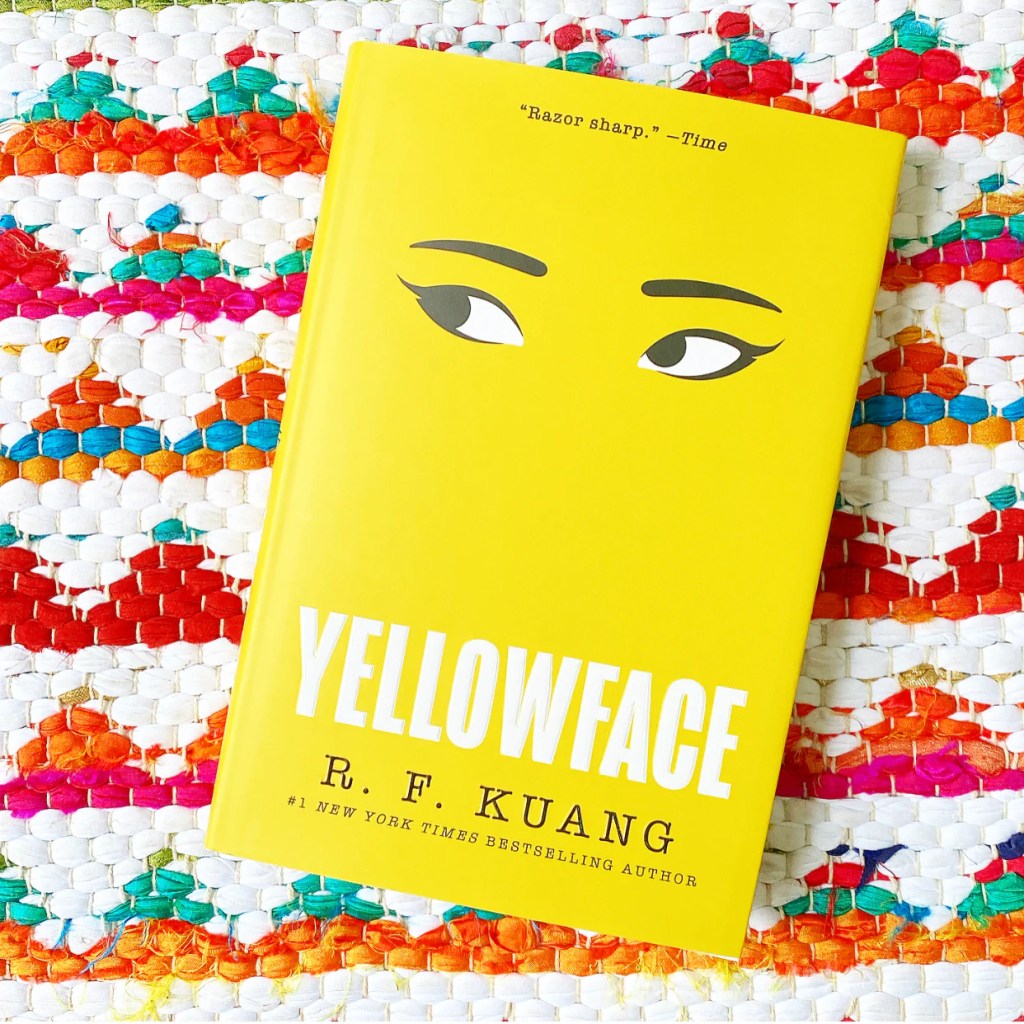
Book Review: Yellowface by R.F. Kuang
Rating: ★★★★☆(4/5)
Introduction:
This book had me rolling my eyes in the best way. This is about a white, non Chinese woman stealing the novel of an Asian woman so that she can tell the true story of Chinese laborers during World War 1. Like Sis, be so for real, you can’t tell this story. While I was in college I had to write a big paper as part of my non-thesis option. I chose the history of Minstrel shows in America and how they shaped the way African Americans are portrayed in the media today. I was 22 and I did all of this research. I learned all the things. The point of the paper was to discuss what research was already out there on the topic. It wasn’t to give my thoughts on anything. It was to teach me how to research. Even at 22, I knew that it wasn’t my place to add to this narrative. I could talk about the history there. I could connect dots, but I will never be a voice for the Black experience. That is where our main character crosses the line. She is delusional enough to think it is okay to speak for the Asian community.
Quick Facts
- Release: May 2023 Read: April 2025
- Reading Time: 6-8 hours
- Pages: 319
- Format Recommendation: I read the EBook and loved it.
- Perfect for: People who love social commentary and a novel that isn’t a romance.
- Spice Level: No🌶️
- Trigger Level:💀💀
Summary: A Brief Overview (Without Major Spoilers)
- Authors Juniper Hayward and Athena Liu were supposed to be twin rising stars. But Athena is a literary darling while June is a nobody. Who wants stories about basic white girls?, June thinks. So when June witnesses Athena’s death in a freak accident, she acts on impulse, stealing Athena’s just-finished masterpiece, an experimental novel about the unsung contributions of Chinese laborers during World War I.
- So what if June edits Athena’s novel and sends it to her agent as her own work? So what if she lets her new publisher rebrand her as Juniper Song—complete with an ambiguously ethnic author photo? This piece of history deserves to be told, whoever the teller. That is what June believes, and The New York Times bestseller list agrees.
- But June cannot escape Athena’s shadow, and emerging evidence threatens her stolen success. As she races to protect her secret she discovers exactly how far she will go to keep what she thinks she deserves.
What Worked for Me:
The Behind the Scenes Feel: As someone who wants to publish a novel one day, I loved reading about the ins and outs of the publishing world. The drama and the idea that a book can be chosen to be #1 by the powers that be kept me on my toes.
The Plot: This feels like it could actually happen. There has been a woman who pretended to be Black and become the head of her branch of the NAACP. There have been politicians who claim to be Native American only for it to come to light that they probably aren’t. It isn’t far-fetched that a white woman could use her middle name to be more ambiguous racially. The concept of should a person be able to tell a story that isn’t a part of their culture fascinates me and I enjoyed the discussion being had in the novel.
What Didn’t Work for Me: Trigger Warnings and Criticisms
June’s “Plight”: As a basic white girl myself I understand June’s thinking. I want to be a writer. It’s been a dream of mine since I was a child. There are stories though that I cannot tell. June couldn’t figure this out. Just because you can tell a story doesn’t mean you should.
The White Girl Narrative: This is a satire about a white woman stealing the work of an Asian woman as told by an Asian author. While I understand the concept of debating who can and can’t tell a story, making the white woman the villain feels like a cop out. As a white woman myself, I get it. We are known for being Karens and not knowing when to shut up, and giving opinions when they are not needed. However, just like how any other culture or race doesn’t like someone who isn’t in their group writing about their stereotypes, I didn’t like it either. I think it is important for someone to be able to share their truth and be able to talk about how they view situations rather than myself feeling comfy. So, while it made me uncomfortable at times, it’s a narrative that needs to be discussed.
Final Thoughts: Between the unreliable narrator and the social constructs being discussed, this book will make you think. I loved it.
📚 Study Guide
- Discussion Questions:
- What did you think of Kuang’s decision to narrate the story in the first person from June’s (unreliable) point of view? Would you have liked to hear from anyone else’s perspective? If so, who, and why?
- June and Athena have a complicated relationship in the novel. Do you think they were ever really friends or was it purely a transactional relationship? What did they each get out of the friendship?
- Athena is also posthumously “canceled” even though she is of Chinese descent, criticized for retelling stories of the Korean community and for rosily representing elements of Chinese history that she has not personally experienced. Do you agree with this “cancellation”?

 ReadRantRepeat
Leave a comment